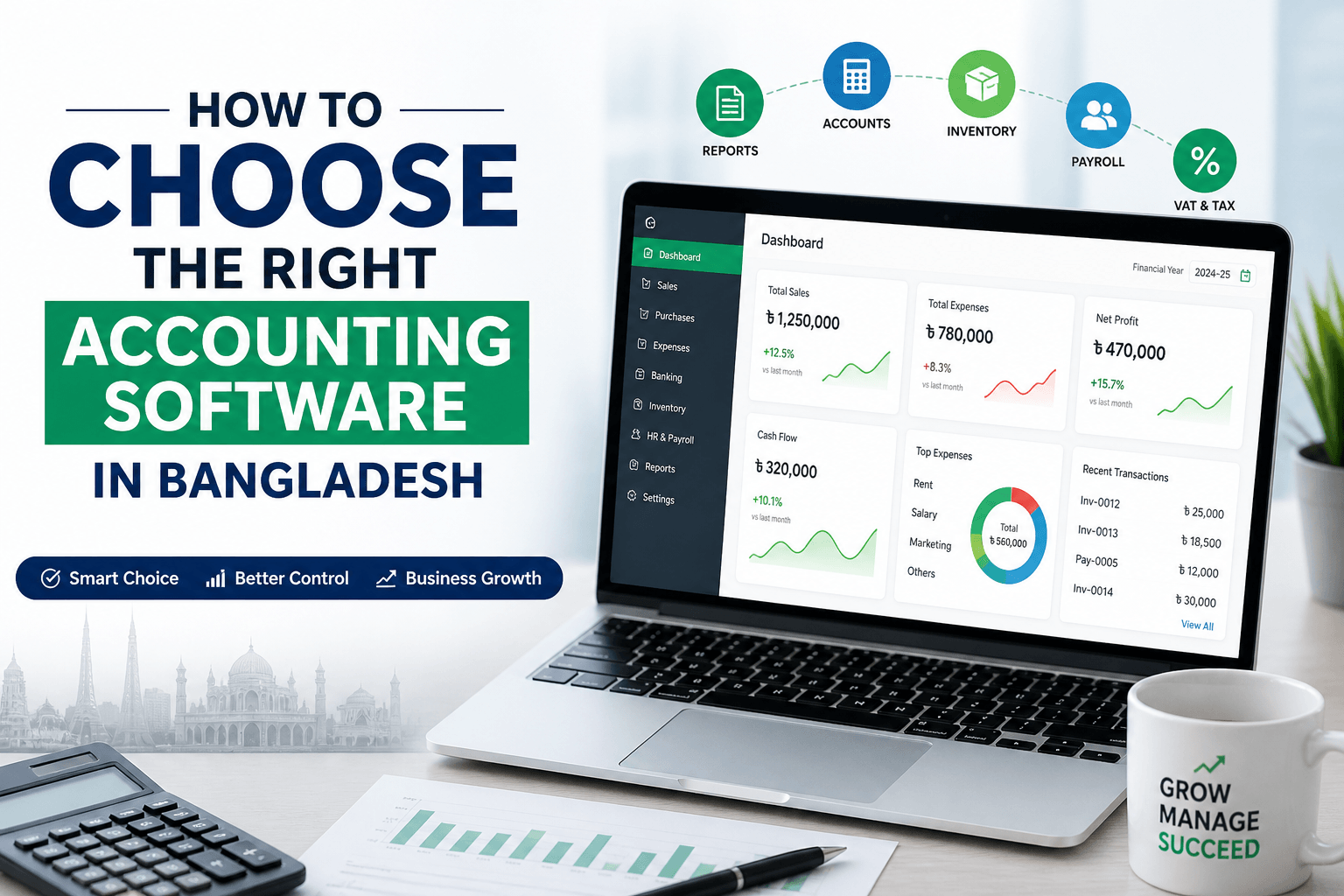
Choosing the right accounting software in Bangladesh is one of the most important decisions for any business owner. Whether you run a small shop, a growing SME, or a large enterprise, the right solution can save time, reduce errors, and help you make smarter financial decisions. On the other hand, choosing the wrong software can create confusion, inefficiency, and even financial loss.
In this guide, you’ll learn how to choose the right accounting software in Bangladesh with practical, real-world considerations tailored to the local business environment.
Why Choosing the Right Accounting Software Matters
In today’s digital business world, manual bookkeeping is no longer efficient. Businesses in Bangladesh are rapidly shifting toward automated solutions to manage accounts, inventory, VAT, payroll, and reporting.
The right accounting software will help you:
- Maintain accurate financial records
- Save time through automation
- Ensure compliance with local tax regulations
- Generate real-time reports for better decision-making
- Scale your business operations smoothly
But not all software is created equal. That’s why choosing carefully is essential.
1. Understand Your Business Needs First
Before you start comparing software, you need a clear understanding of your own business requirements.
Ask yourself:
- Do you need inventory management?
- Will multiple users access the system?
- Do you require payroll features?
- Is VAT calculation important for your business?
- Do you operate multiple branches?
For example, a retail shop may need POS and inventory features, while a manufacturing business may need production management. Choosing software without matching your needs is a common mistake.
2. Look for Bangladesh-Specific Features
One of the biggest factors when you choose the right accounting software in Bangladesh is localization.
Your software should support:
- Bangladeshi VAT and tax rules
- Local currency (BDT)
- Bangla language (optional but helpful)
- Local reporting formats
Many international software tools lack proper support for Bangladesh-specific requirements, which can create complications in compliance and reporting.
3. Ease of Use is Critical
No matter how powerful software is, it’s useless if it’s too complicated.
Look for:
- Simple and clean interface
- Easy navigation
- Minimal training requirement
- Clear dashboards and reports
Your staff should be able to learn and use the system quickly. Otherwise, productivity will suffer.
4. Cloud vs Desktop: Which One Should You Choose?
In Bangladesh, both cloud-based and desktop accounting software are popular.
Cloud-Based Software:
- Access from anywhere
- Automatic updates
- Data backup and security
- Ideal for growing businesses
Desktop Software:
- Works offline
- One-time cost (in many cases)
- Suitable for small businesses with limited internet access
If your business is growing or you have multiple branches, cloud software is usually the better option.
5. Check Key Features Carefully
When selecting accounting software, always evaluate the core features. A good solution should include:
- Financial accounting (ledger, journal, reports)
- Inventory management
- Sales and purchase tracking
- VAT and tax management
- Payroll system
- Reporting and analytics
Advanced features like manufacturing, project accounting, and fixed asset management can be a big plus depending on your business type.
6. Scalability for Future Growth
Don’t just think about your current needs—think about where your business will be in 2–5 years.
Choose software that:
- Can handle increased data volume
- Supports more users
- Offers advanced modules when needed
Switching software later can be costly and time-consuming, so it’s better to choose a scalable solution from the beginning.
7. Customer Support and Training
In Bangladesh, reliable customer support is extremely important.
Look for:
- Local support team
- Fast response time
- Training and onboarding assistance
- Documentation and tutorials
If you face issues and can’t get quick support, your business operations may be disrupted.
8. Pricing and Value for Money
Budget is always a consideration, but the cheapest option is not always the best.
Compare:
- Initial cost
- Monthly or yearly subscription
- Hidden charges
- Cost of additional features
Instead of focusing only on price, consider the overall value. A slightly higher investment can save you significant time and money in the long run.
9. Data Security and Backup
Your financial data is extremely sensitive. Make sure the software provides:
- Secure data storage
- Regular backups
- User access control
- Protection against data loss
Cloud software usually offers better security, but only if it’s from a reliable provider.
10. Reviews and Reputation
Before making a final decision, check:
- User reviews
- Client testimonials
- Market reputation
- Number of active users
Software with a strong user base and positive feedback is generally more reliable.
11. Try Before You Buy
Always request a demo or trial version.
During the trial:
- Test key features
- Check usability
- Evaluate speed and performance
- See if it matches your workflow
This step can prevent costly mistakes.
Common Mistakes to Avoid
When trying to choose the right accounting software in Bangladesh, many businesses make these mistakes:
- Choosing based only on price
- Ignoring local compliance features
- Not testing the software before buying
- Overlooking customer support
- Selecting overly complex systems
Avoiding these mistakes will help you make a smarter decision.
Final Thoughts
To choose the right accounting software in Bangladesh, you need to balance features, usability, cost, and local compatibility. There is no one-size-fits-all solution—the best software depends on your specific business needs.
Take your time, do proper research, and always test before committing. The right choice will not only simplify your accounting but also give you better control over your business growth.